Human Resources / 2026 / prototype
An HR system for recruitment, employee records, contracts, attendance, and leave.
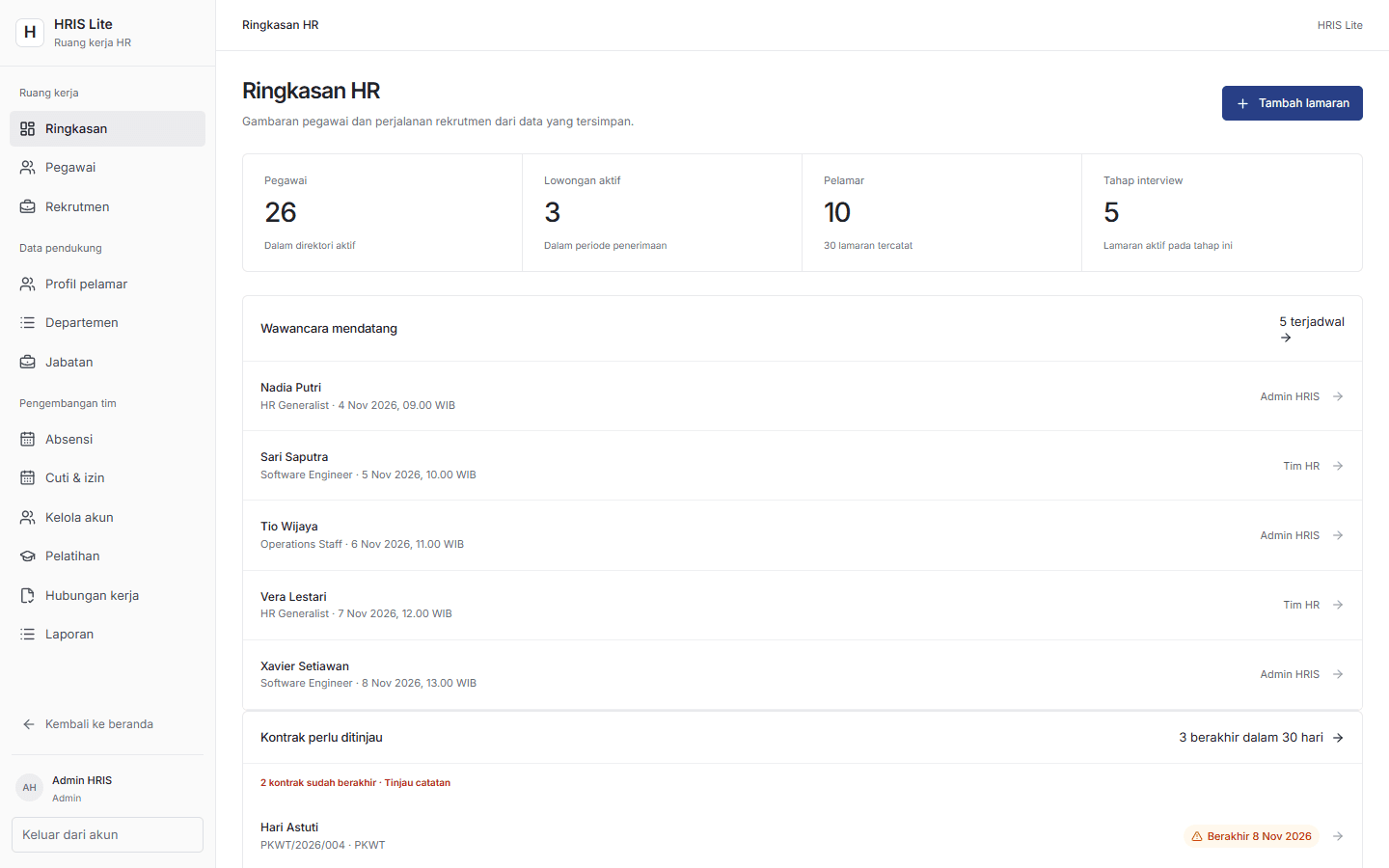
HR teams handle sensitive records across hiring, contracts, training, discipline, attendance, and leave. HRIS Lite brings that work into one Indonesian-language app where five roles see only what they should, and important changes leave a record. It is a portfolio prototype with fictional data: no HR team has tested it yet, and it is not on always-on hosting.
Vacancies, a public careers portal, screening, interview scheduling that rejects clashes, offers, and converting an accepted applicant into an employee.
Search and filter employees, and archive with a reason instead of deleting. CSV or XLSX imports are validated row by row, then saved all at once or not at all.
PKWT and PKWTT contracts with versioned PDFs, a 30-day PKWT expiry reminder, a list of active employees without a current contract, and warning letter records.
Web check-in and check-out, work schedules, correction and leave requests reviewed by the supervisor and then HR, and monthly recaps exported to Excel or PDF.
One admin page combines the history of ten sources, showing who did what and when.
Laravel 13 runs the backend with MySQL 8.4, and Inertia.js renders the React and TypeScript interface without a separate API layer. Gates and policies enforce access on the server for five roles: Admin, HR Staff, Viewer, Employee, and Supervisor. CVs, contracts, and other PDFs stay on a private disk and download only after authorization. Times are stored in UTC and shown in WIB. Email still goes to a log, so applicant verification and password reset links do not reach real inboxes yet.
Forms carry a version and the server takes a row lock, so a stale tab is rejected instead of overwriting someone else's change. Interview and attendance scheduling are serialized with locks to prevent clashes.
Viewers still see names and job data, but work email, phone numbers, and applicant emails are never sent to their browser and are left out of their search. The rules live in server-side gates and policies, not in hidden buttons.
Each module writes its own event table in the same transaction as the change. The audit page merges ten sources with UNION ALL and adds filters and pagination on top.
Source: docs/STAGING.md, 3 Nov 2026
LET’S BUILD SOMETHING GOOD
Tell me what you want to build, improve, or explore.
